Turning Close Reading Into Strong Analytical Writing
Throughout this series, I have shared the nonfiction close reading process that I developed through years of working with my students and refining strategies that helped them better understand nonfiction texts.
During the first read, students focus on understanding what the article is mostly about.
During the second read, students begin digging deeper into the text. They annotate important details. They identify relevant evidence. They organize their thinking using the two-column notes organizer and the Question and Answer strategy.
By the time students complete these first two stages, they have interacted with the text multiple times and have also gathered a strong collection of ideas and evidence.
The final step in the process is helping students turn that information into a clear written response.
This is where content-specific organizers become incredibly valuable.
During the third read, students begin connecting everything they learned during the earlier stages of reading. Instead of simply identifying evidence in the text, students now organize their thinking so they can clearly explain the author’s ideas in writing.
This stage helps students move from gathering information to analyzing and explaining their understanding of the text.
Why Students Often Struggle With Writing About Nonfiction
Many students struggle with writing about nonfiction texts because they are asked to explain their thinking before they have fully organized their ideas.
Teachers may ask students to write about the central idea, analyze the author’s purpose, or evaluate an argument. However, without a clear structure for organizing their thinking, students often feel overwhelmed when they begin writing.
Some students repeat information from the text without explaining it. Others include evidence that does not directly support their response.
Over time, I realized that students needed one more step between reading and writing. They needed a tool that helped them connect the information they gathered during the first and second reads to the specific skill they were being asked to analyze.
This is where content-specific organizers make a powerful difference.
How Content-Specific Organizers Bridge Reading and Writing
Content-specific organizers help students connect their reading notes to the specific skill or standard they are working on.
Rather than starting with a blank page, students use the evidence they gathered during the second read and organize it according to the question they are trying to answer.
For example, if students are identifying the central idea of a text, the organizer may include spaces for:
- the central idea of the article
- key supporting details from the text
- explanations of how those details support the central idea
If students are analyzing the author’s purpose, the organizer might guide them to identify:
- explanations of how the evidence supports their reasoning
- the author’s main message
- evidence that reveals the author’s purpose
By organizing information this way, students begin connecting their reading notes directly to the thinking required for the writing task.
What The Third Read Looks Like In My Classroom
Using Different Organizers to Differentiate Instruction
Another strategy that has been especially helpful in my classroom is using different versions of the organizer to support students at different levels of readiness.
In the nonfiction reading guide, I include two versions of the central idea and supporting details organizer. Both organizers guide students through the same thinking process, but they provide different levels of support depending on what students need.
Breaking the Task into Manageable Parts
For some students, a more structured organizer works best. This version breaks the task into smaller steps and provides clear prompts that guide students through identifying the central idea and selecting the supporting details from the text.


The organizer includes a place for each section of the text. Students will use their notes from the two column organizer to identify the main idea of each section. They will need to include 2-3 details from that section that supports the main idea for the section.
The additional structure helps students focus their thinking and prevents them from feeling overwhelmed by the writing task.
No Scaffolding Needed, No Problem

Other students may be ready for a version of the organizer that provides less scaffolding. This version still helps students organize their ideas, but it allows them to take more ownership of the process by determining which evidence is most important and how those details connect to the central idea.
Using multiple versions of the organizer allows me to easily differentiate instruction while keeping all students focused on the same reading skill.
Students who need more guidance can work with the scaffolded organizer, while students who are ready for more independence can use the less structured version.
This flexible approach allows every student to participate in the same close reading lesson while receiving the level of support they need to be successful.
Over time, many students who begin with the more structured organizer are able to transition to the less scaffolded version as they develop stronger reading and writing habits.
How I Model This Step for Students
By the time students reach this stage of the lesson, they have already gathered important evidence from the text during the first and second reads.
The goal now is to help them use that information to determine the central idea and explain how the supporting details connect to it.
The notes students created during the second read become the foundation for this step. The evidence students identified in their two-column organizer now helps them determine the central idea and explain how the supporting details connect to the author’s message.
Students who demonstrated a strong understanding during the first and second reads get the single organizer with guiding questions.
These students are typically ready to work through the organizer independently. The questions help them organize their thinking, but they do not need additional scaffolding or modeling to determine the central idea and supporting details.
Supporting Students Through Modeling
Other students may need more support in organizing their thinking. For these students, I provide a more structured organizer that breaks the text into sections and guides them through identifying the supporting details and central idea step by step.
For this group, I begin by modeling how to complete the organizer using the first section of the text.
I start by looking back at the details we identified during the second read in the two-column notes organizer for that section of the article. These details become the supporting evidence for the section we are analyzing.
As I model the process, I explain my thinking by asking a few key questions:
- What details did we identify in this section of the text?
- What do these details have in common?
- How do these details help reveal the main idea of this section?


Using those questions, I show students how the two or three key details from the two-column notes can be used as supporting evidence. Then we determine the main idea of the section based on what those details reveal about the author’s message.
Once students see how the process works with the first section of the text, they begin working through the remaining sections of the organizer independently.
While students are working, I actively monitor their progress, circulate around the room, and provide support for students who may still be struggling. This allows students to think for themselves while still receiving guidance when they need it.
Turning the Organizer Into a Constructed Response
Once students complete the content-specific organizer, they are ready for the final step of the lesson: writing a constructed response.
At this point, students have already completed most of the thinking required for the writing task. They have identified the central idea of the text and gathered two or three pieces of supporting evidence.
The only thing they have left to do is explain in their own words how those supporting details connect to the central idea.
Here’s an example constructed response prompt:
What is the central idea of the nonfiction article “Social Media in Today’s Society”? Be sure to use the key ideas and supporting details from the text in your response.
Because students have already organized their ideas in the content-specific organizer, they can focus on clearly explaining their thinking rather than trying to decide what to write about.
Providing Success Criteria for Student Writing
Before students begin writing, I share the success criteria for the constructed response.
These criteria help students understand exactly what a strong response should include.
Students are asked to include three key components in their response:
- a detailed explanation of how each piece of evidence connects to and supports the central idea
- a clear statement identifying the central idea of the text
- two to three pieces of text evidence that support the central idea
Providing clear expectations helps students focus their writing and understand what successful responses should look like.
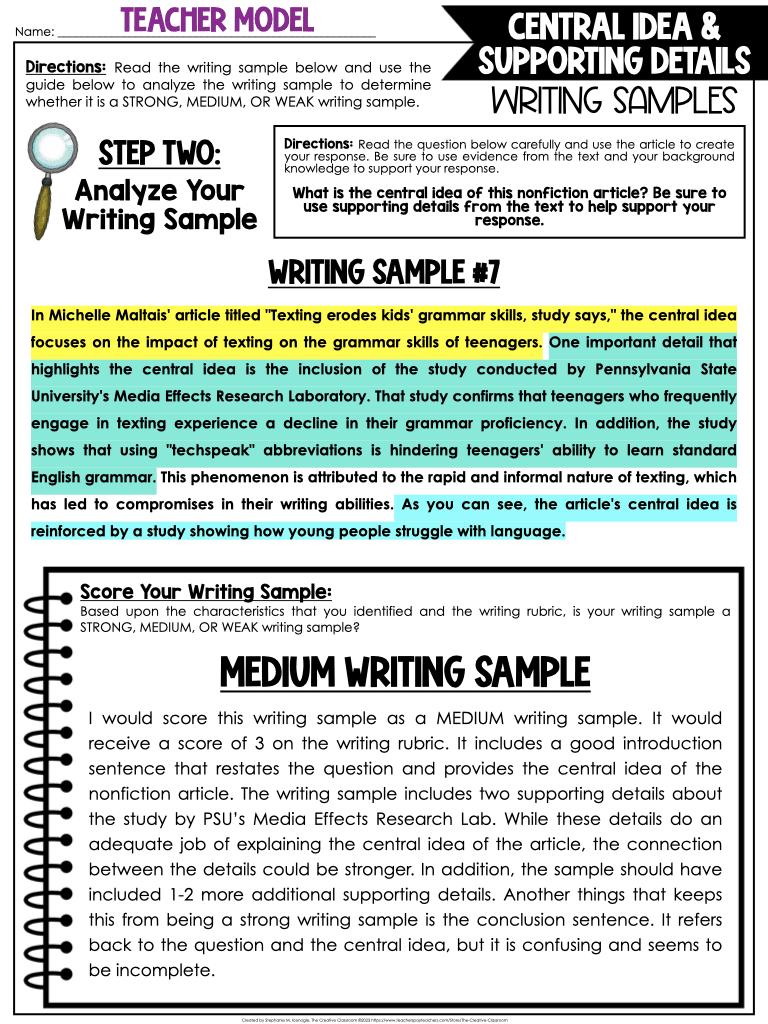
Let Your Students Create The Criteria for a Strong Writing Composition
If you want to challenge your students to create their own success criteria, I have a simple strategy that teaches students how to analyze sample writing compositions. Students must identify what components are needed to be considered strong or what pieces a weak writing sample is missing.
You can learn more about this strategy in my blog post, Writing Strategies Series #2: Analyzing Strong, Medium, and Weak Writing Samples. Click here to visit that post and grab a FREE lesson on analyzing writing samples.
Using Student Writing Samples for Self-Assessment

To further support students during the writing process, I always give them examples of strong, medium, and weak student responses.
These writing samples not only serve as models but also allow students to self-assess their own writing.
If this is the first time your students are being asked to self-assess their writing, you may want to model this process for them. You can also give students guiding questions to help them self-assess their writing:
- Which writing sample does your response most closely match?
- What is keeping your response from being a STRONG writing composition?
Typically, I will use the same writing prompt type that students are answering with a different text. For example, when students are completing a writing composition for the social media article, your models would be based on the question “What is the central idea of the nonfiction article ‘Good Attendance Equals Good Grades at School’?”
This allows you to show students the expectations for the assignment and the thinking required WITHOUT doing the thinking for them. If you gave students writing models based on the social media article, they can easily copy the models. They could also get ideas for their own writing composition.
This extra step encourages students to reflect on their writing and make improvements before submitting their final response. It will hopefully get your students into the mindset of stopping and reflecting on their writing instead of rushing through the writing task.
Bringing the Close Reading Process Together
Each stage of this close reading process serves a specific purpose.
During the first read, students focus on understanding what the text is mostly about.
During the second read, students dig deeper into the text by identifying relevant evidence and organizing their thinking.
During the third read, students connect their ideas and evidence to the specific reading skill they are analyzing and explain their thinking in writing.
By moving through these stages consistently, students develop stronger habits for interacting with complex nonfiction texts.
Instead of guessing or rushing through reading tasks, they learn how to gather evidence, organize their ideas, and clearly explain their understanding.
Looking for Ready-to-Use Close Reading Resources?
If you like the strategies shared in this series but would prefer ready-to-use materials for your classroom, I’ve created several nonfiction close reading resources that follow the same framework used in this guide.
These resources include
- structured close reading activities
- two-column notes organizers
- content-specific graphic organizers
- student writing + assessments
- answer keys + models
- guided lesson powerpoints
You can explore a few of my most popular nonfiction reading resources below:


Each resource is designed to help students move through the close reading process step-by-step while saving teachers valuable planning time.
Related Posts

2 Nonfiction Reading Tools That Help Students Dig Deeper Into The Text During the Second Read

Why So Many Students Struggle With Nonfiction Reading Comprehension (And 3 Effective Steps ELA Teachers Can Use)

The First Read Strategy That Improves Nonfiction Reading Comprehension and Builds Stronger Readers